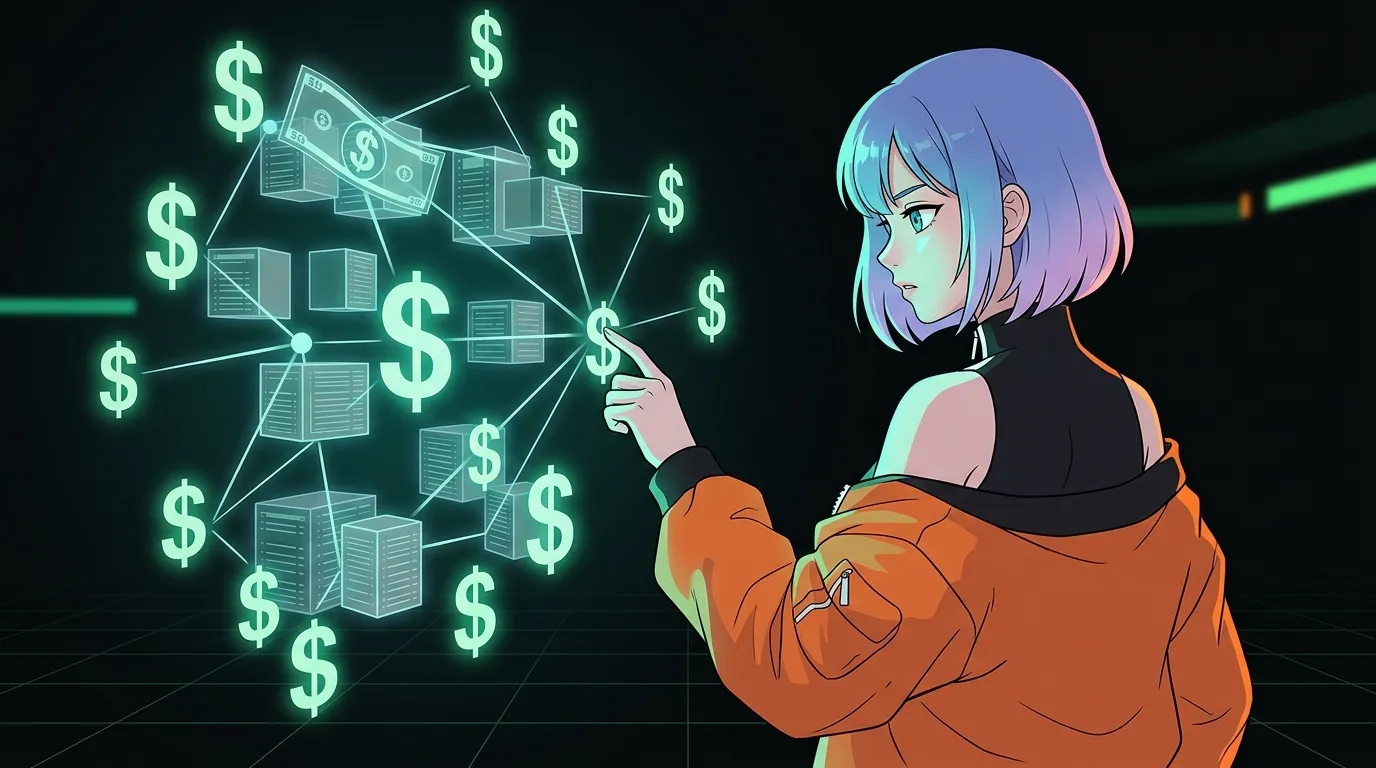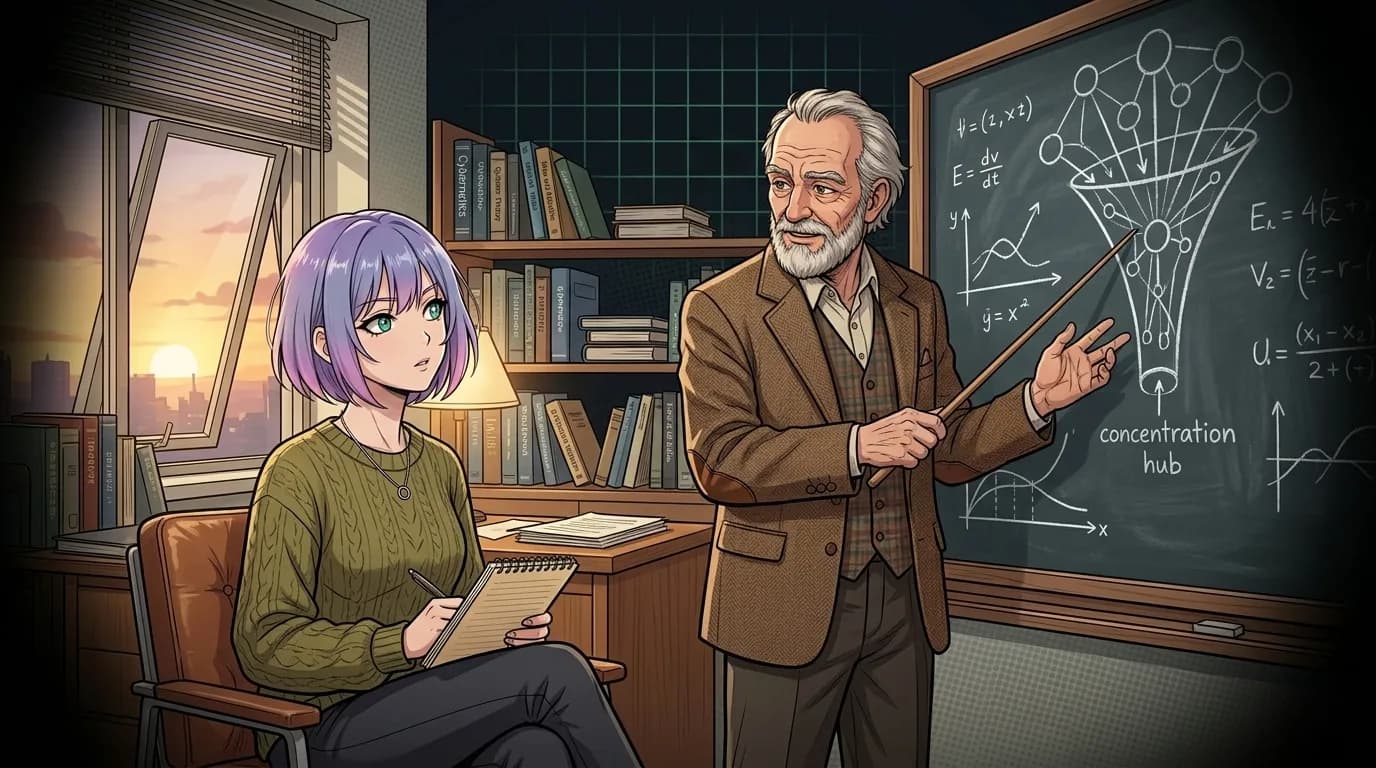
Something has bothered me for a long time: every technology that promised to free information delivered the opposite. Decentralization in the discourse, concentration in practice. And it is not an accident, historical bad luck or a betrayed ideal. It is network physics.
The indie phase always ends
Gutenberg's press was going to democratize knowledge. It became the infrastructure nation-states used to standardize language, propaganda and fiscal bureaucracy. Radio was going to give the people a voice. It gave a voice to Goebbels and to the New Deal with the same efficiency. The internet was going to be the horizontal agora. It consolidated into five companies that know you are about to end a relationship before you do.
The pattern repeats so cleanly you can draw it. Every new medium is born expensive and chaotic, the indie phase. It gets cheap and ubiquitous, the mass phase. And then whoever controls the distribution layer, not the creation layer, captures the surplus.
Shoshana Zuboff called it behavioral surplus. Nick Srnicek called it platform logic. I feel it is the part the accelerationist pitch always skips.
 Gutenberg e Helen: a primeira grande reconcentração
Decentralizing is expensive
The reason is more uncomfortable than "humans are disorganized". It is that coordination has asymmetric costs. Decentralizing demands that every node pay the price of verification, redundancy, slowness. Centralizing outsources that cost to a single point and hands back convenience. And we humans tend to trade sovereignty for convenience. Some will call that moral weakness. But I believe it is a social thermodynamic gradient: water runs down to the valley of least effort. Doing the opposite is enormously expensive in energy, and the ones who have that energy are the young; the body gradually burns through it (young revolutionary, conservative adult).
Every victory of decentralization carries, in its own code, the vector of the next reconcentration:
-
Satoshi solved money, and Bitcoin reconcentrated into mining pools.
-
Bitcoin became a store of value acquired by nation-states and mega corps.
-
Torrent solved distribution, and reconcentrated into three indexers.
The market always finds the point of reaggregation.
 A nobreza de timestamp: os que chegaram cedo recebem a coroa
AI is cheap coordination
Here is where it gets dark for anyone orbiting web3 and AI carrying the flag of decentralized accelerationism.
AI is, before anything else, a technology of cheap coordination. It drops to near zero the cost of aggregating, predicting and managing millions of people. Which is exactly the input the ultimate centralizer was missing.
Before, the bottleneck of total control was cognitive. No bureaucracy could process everyone in real time. The Stasi needed an informant for every two citizens. Now it needs no informant at all. The bottleneck evaporated.
The cruel twist: the same tools that give you the solo indie hacker superpower, orchestrating alone what used to demand a team of twenty, are the ones that hand total-surveillance superpowers to whoever already owns the distribution layer. The knife does not choose the hand. You and the adversary are sharpening the same blade. The difference is that he is already holding the handle.
This extraction of power needs a "them"
Except efficiency does not explain everything. If it were only about cost, concentration would be cold, technical, almost administrative. It is not. It is moral.
Mancur Olson dedicated two books to this thesis; one interesting cut here: in any group, collective action suffers from free riders, so those who organize into cohesive subgroups capture disproportionate gains from the larger, disorganized collective. He called them distributive coalitions. He treated it as an almost technical bug, a failure of scale.
What he left loose is the part cold game theory does not like to face: the bug needs a moral narrative to stabilize itself. Raw power is unstable. Extracting without justifying breeds revolt, costs repression, gets expensive. So the extracted surplus needs to be laundered into legitimacy. And the cheapest detergent in history is differentiation.
W.E.B. Du Bois saw it in the poor white worker of the American South. He earned little in money, but received a public and psychological wage: the symbolic payment of not being the Black man. That bought his loyalty to the system that exploited him. Functional and disgusting in equal measure.
The fuel is merit bias. Since everyone genuinely feels they worked harder, nobody at the top sees themselves as unjust. The exploiter does not see himself exploiting. He sees himself justly rewarded, and sees the one below as someone who contributed less. Cruelty does not need a conscious villain. It only needs a universal cognitive bias, overestimating one's own effort, running at population scale. Each part operates in good conscience, and the aggregate produces castes.
The nobility of those who arrive first
Technological decentralization dissolves a power structure and, for an instant, releases raw power. That is the discovery phase, the indie moment. But it does not dissolve merit bias nor the economics of cohesive coordination. So the vacuum is filled by the same people who always fill it: the ones who understand the structure fastest.
Web3 promised to banish the intermediaries and produced a new aristocracy: those who came in early and grasped the mechanics, the OGs. We traded the nobility of blood for the nobility of timestamp (the date-and-time stamp every digital record carries): the family crest became the proof that you arrived first. The us-versus-them is now genesis block versus latecomers, bitcoiners versus altcoiners, the true ones versus the false ones.
So the honest question, and I do not have the answer, is whether AI breaks this cycle or is just its fastest version. I tend to think it is the fastest version. Human organization is complex, alignment is hard, and the water keeps running down to the valley.
It gets difficult for anyone who believes accelerating the technology solves the rest: can we build a system where the surplus does not need a narrative of inferiority to sustain itself? Or is every durable order, at bottom, a machine for manufacturing a "them"? Is this fundamentally our nature? Or will we produce a surplus with AI that satisfies the great ambitions, without simultaneously throwing others into sub-human conditions?
Make no mistake, I love decentralization, open source culture, being technologically agnostic and not binding myself to entities that concentrate colossal power. But I find myself fearful and thoughtful about what is coming, and about how we can do better.