Think like water, adapt like context, build like a system. I have used that line around here for a while, always as a posture. I never imagined water itself would give me a lesson in epistemic humility.
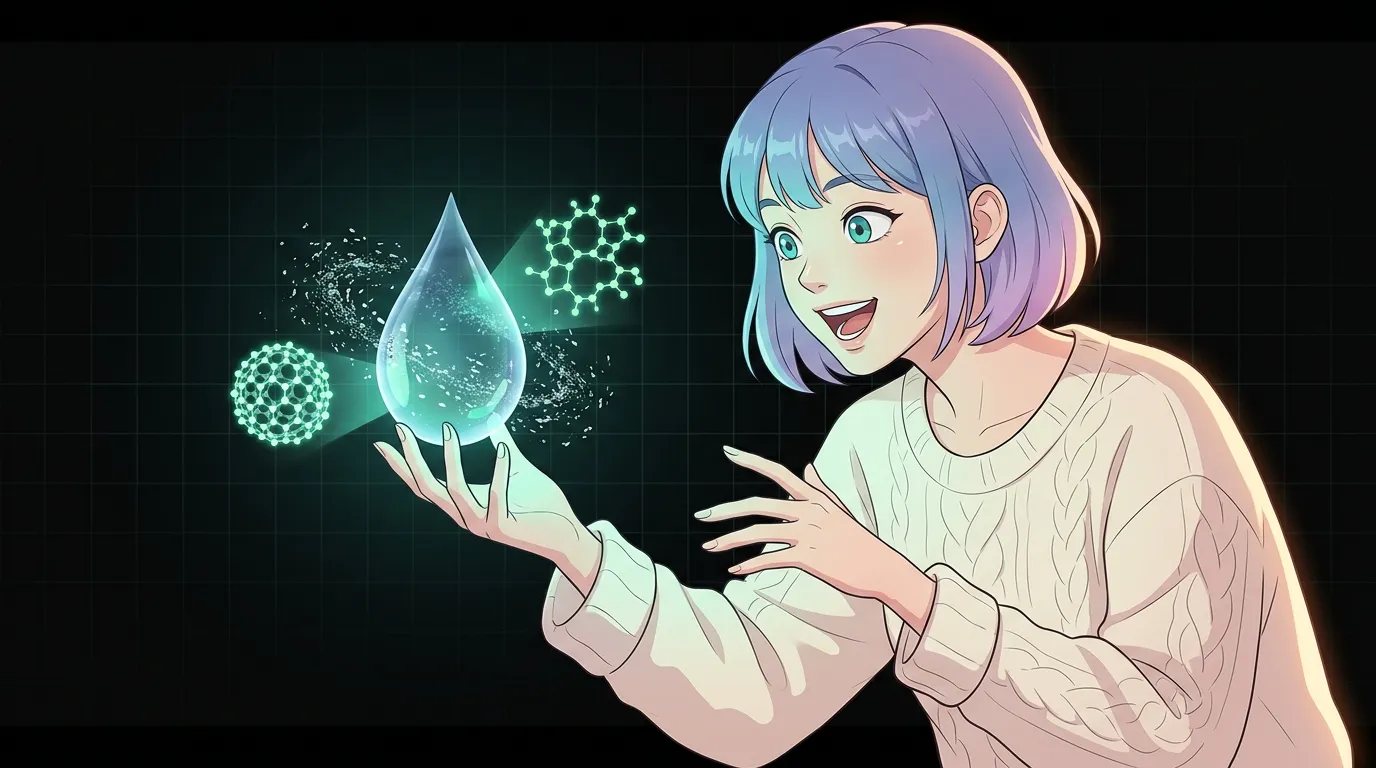
In 2026 a paper came out in Nature Physics that used unsupervised artificial intelligence to confirm a hypothesis from 1992: liquid water is not one single thing. It lives in two phases, one dense (HDL) and one less dense (LDL), and switches between them depending on pressure and temperature. It is not ice turning into liquid. It is liquid turning into another liquid, without ever leaving the liquid state.
The most common thing on the planet. The one we drink every day, measure, boil, freeze since we were human. And it took 34 years of serious physics to prove it has two bodies.
What we swear we know
That interests me more than the water itself. Water is the example of the absolute obvious. If there is one thing humanity thinks it has mastered, it is the glass of water. And even there, on the firmest ground there is, an entire discovery was hiding.
I like feeling this. Not as a defeat, but as a beautiful invitation. If water still has something to teach, imagine the rest. The whole planet is like this, full of structure we cross every day without seeing, because we never had the resolution to see it. Absolute certainty is almost always just the size of our sample disguised as final truth.
 A IA traduziu o ruído em dois padrões
AI as translation, not as oracle
What changed in 2026 was not the theory, it was the lens. The researchers ran the most advanced molecular simulations there are and let an unsupervised model loose on top, without telling it what to look for. The AI found the two geometric patterns on its own, cleaned up the noise that had blurred three decades of debate.
And this is where I stop talking about physics. What the AI did there was translate. It took a molecular chaos that no eye and no classical statistics could resolve, and gave it back in a format we can read.
That is why I find the tool truly powerful. Not for the text it generates, but for being a translator that does not tire, does not get lost in the monotony of millions of data points, and does not carry as many of the biases we carry, the ones fueled by our own feelings, by the wish for the result to come out a specific way. The AI looked at the data without rooting for any side. A human tires, clings to their own hypothesis, wants to be right. The model just translated what was there.
 Cristal que rasga, vidro que preserva
But the water itself, what changes?
Good question, and the answer is less abstract than it seems. Understanding that water has two liquid phases is understanding the rules of when and how it turns to ice. And controlling ice crystals is one of the most valuable games in applied science.
When water freezes, it forms crystals. A crystal has points, has edges, and rips a cell wall from the inside. That is why thawed meat leaks water and loses texture, and it is why, in a far more serious problem, we still do not know how to freeze an organ for transplant without destroying it in the process.
With a finer map of the liquid phases, the control gets genuinely rigorous: you can know where water crystallizes, where it can stay liquid below zero, and where it turns to glass instead of ice (vitrification). Then the application list opens up:
- 🫀 Organs for transplant. Today a heart or a kidney has a window of a few hours outside the body. If you can vitrify without crystals, that window becomes months. It changes the entire math of the transplant queue.
- 🧬 Cells, embryos, tissue. Freezing eggs, stem cells and blood is already routine, but still loses samples to crystals. Fewer crystals, less loss, more people served.
- 🧪 Medicine and new materials. A protein only works folded the right way, and it folds inside water. Understanding the water underneath is understanding the chemistry of life, and designing better molecules from there.
- 🍦 Food. It sounds silly next to organs, but freezing without wrecking texture is a billion-dollar industry, and it is good food that lasts longer on more people's tables.
None of these is science fiction. They are research lines that stall at exactly the point this paper unlocked: knowing, with precision, what water does when nobody is watching at the molecular scale.
The tool we made ourselves
And the detail that closes it for me: this lens did not fall from the sky. It is one more of the tools we ourselves created, in the same lineage as the microscope, the telescope, the particle accelerator. Each of those widened what the human race could see, and each was made by the very race it widened.
AI is next in that line. An instrument of translation that empowers us to go further, not by replacing human curiosity, but by giving it resolution. And the most beautiful part is that the same technique that confirmed the water is the one that will unlock the applications I listed up there. Curiosity and utility pull on the same rope.
The verdict
For now, what I keep thinking is this: we spent our entire history looking at water thinking we knew what it was, and we only knew the average. Now we have a translator that sees structure where we only saw noise.
I feel small with this. I feel like I am at the beginning. There is a lot to learn on this planet, much more than our certainty lets show, and for the first time we have a tool made by us, big enough for the size of the thing.
What else that you swear you are absolutely sure of has not been properly translated yet?