The most powerful man in the known world would wake up, put on the purple of a Roman emperor and, before deciding the fate of millions, write himself a note remembering that he was going to die and turn to dust like anyone else.
That note became a book. It is called Meditations. I am reading it now, slowly, and it calms me down in a way no meditation app with chimes and a spa-announcer voice ever managed.
I am not a philosopher. I am a guy with a racing head, who lives off cycles, charts and a timeline that never sleeps, and who on one of these nights opened a man dead for almost two thousand years and took a slap of perspective. Let me try to explain why.
A journal that was never meant to be read
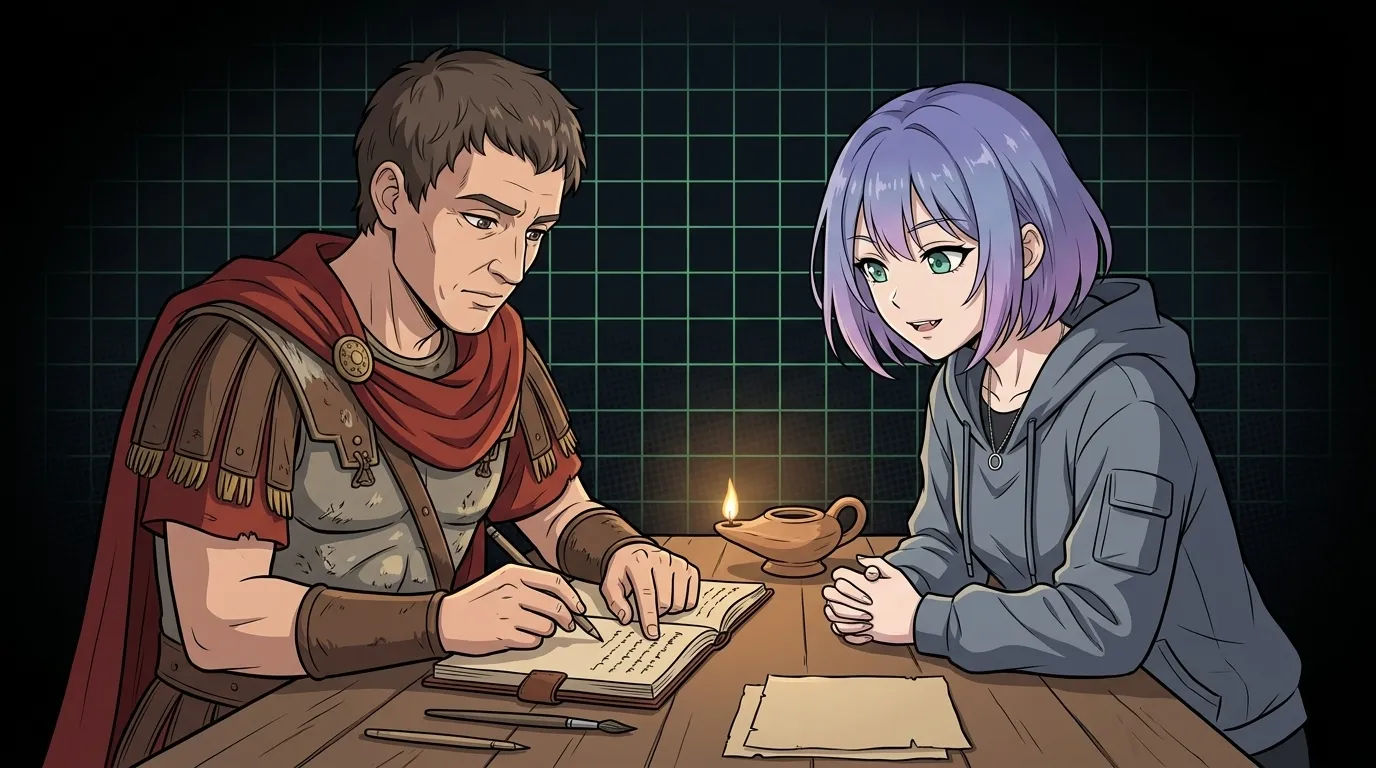
Meditations was not written to be published. Marcus Aurelius wrote it for himself, in Greek, in the middle of a military campaign, in the mud of the camp, between one war and the next. The title closest to the original is something like "To himself". It never had an editor, never had an audience, never had a thread.
Think about the contrast. We live in the era of building in public, of the flex, of the documented 5am routine, of the posted breakfast. And the most intimate, most useful text an emperor left behind is precisely the one he wrote believing nobody would ever read it. No audience, no algorithm, no dopamine from a like. Just him and his own head.
That changes completely how you read it. There is no pose. When he writes "stop complaining", he means himself. When he talks about vanity, anger, pride, it is a diagnosis of his own flaws, not a sermon for a crowd. It is a man who could do anything forcing himself, on paper, to be better than power allowed. Honesty at that level is rare in any era.
 O diário analógico contra o ruído digital
The racing mind and the dichotomy of control
My hurry is not exactly a character flaw. It is the environment. I live in a world of market cycles, one-minute candles, FOMO, a notification every fifteen seconds. The whole place is designed to keep you accelerated. But the Stoics have a cheat code for this, and it is simple to the point of being irritating.
It is called the dichotomy of control. Separate what is under your command (your actions, your judgments, your character) from what is not (the market, other people's opinions, the outcome, death). Suffering over the second group is pure waste. Epictetus formulates it first, Marcus Aurelius practices it in the journal, page after page, because he kept forgetting too and needed the reminder.
For someone from my corner of the internet, this is risk management for the soul. You do not control whether the trade goes up. You control the position size, the thesis, the discipline of not panic-selling at three in the morning. The Stoic just extends that ruler to all of life: you do not control whether people like you, you control whether you acted right. The rest is noise you should not be spending emotional capital on.
There is an image from the book I cannot get out of my head. He tells himself to be like the headland the waves crash against without pause: the rock stands firm, and around it the fury of the water falls asleep. It is not about not feeling the wave. It is about being the stone, not the foam.
 A dicotomia do controle em prática
Empires turn to dust (and that is a relief)
The thread that got me the hardest, though, was death. Not just mine. The death of empires.
Marcus Aurelius was the peak of Rome, the height of all the power that existed on the planet, and he knew it would end. He writes about Alexander the Great and his stable boy ending up in exactly the same place: the earth. He notes that within a few generations nobody will remember your name, nor the people who remembered you. "Soon you will have forgotten all things, and soon all things will have forgotten you."
You would expect that to be depressing. For me it does the opposite: it is a relief. Because it puts today's noise at the right scale. If Rome became ruins and the most powerful man in the world became dust, then your Twitter beef, your portfolio in the red, your anxiety about falling behind, all of it shrinks back to its real size. Memento mori, remembering that you will die, is not morbid. It is zooming out.
And for me the mortality of empires is not even abstract. I have watched an "Ethereum killer" L1 be born, promise the world and die. I have watched projects do a 100x and go to zero inside the same cycle. I have watched entire narratives turn to dust between one winter and the next. The fall of empires, for anyone from this market, is not a history lesson. It is a Tuesday. Marcus Aurelius just handed me the version from two thousand years ago, with the same lesson and more scars.
I started thinking of memento mori as the ultimate cold storage of perspective. You keep the awareness of your own finitude in a cold wallet, away from the heat of the day, and it protects you from FOMO every time the market tries to convince you that this very second is the most important one of your life. It is not. Almost nothing is.
Shoulders of old giants
Why read a man dead for two thousand years instead of the latest productivity thread? Because the problem is the same. Technology changed everything except the human head. Fear, vanity, anger, hurry, thirst for approval: the hardware is identical to Rome's. We traded the toga for the timeline and we keep running the same bugs.
Standing on the shoulders of giants is not just for science and code. It works for the soul too. Someone has already felt, with precision, what you are feeling right now, and had the generosity to leave notes. For free. It is the oldest open source there is, and nobody needs permission to clone it.
And then there is the part about honor, which may be the last thing you expect an ancient book to make sound current. For the Stoic, the only real good is virtue, character, the way you act. Money, status, fame, all of that is "indifferent", it can come and it can go, it was never truly yours. What stays is how you carried yourself. In a world that measures everything in public metrics, in numbers everyone can see, this is almost subversive: the only thing that truly matters is precisely the one nobody is watching.
He sums it up in a sentence I have reread about ten times. Do not live as if you had ten thousand years ahead of you. Death hangs over you. While it is possible, while you still breathe, become good.
Stoicism is my mental cold storage
I did not become a hardcore Stoic. I did not quit the game, did not leave the cycles, did not close the chart forever. I am still here, in the noise, head racing again tomorrow morning. The difference is that opening Meditations became a zoom-out ritual before the day swallows me whole.
What I take from the book, in the end, is more or less this. The hurry belongs to the environment, it is not my obligation. What I control is little, and it is everything that matters. Empires fall, I will fall, and finding that out liberates instead of paralyzing. And character is the only position in the portfolio that never goes to zero, because it is the only one that depends on nobody else.
It is not a formula. It is not a five-step productivity hack. It is a powerful man, two thousand years ago, whispering to his own head almost the same things I need to hear today, with the advantage of not trying to sell me anything. The shoulders are there, steady as the headland. All you have to do is climb.