When Marcel Duchamp put a urinal in a gallery in 1917, he knew exactly what he was doing: destroying the romantic notion of art as something based exclusively on manual technique. He repositioned the focus as the fruit of a concept, of a declared intention recognized by an audience. Art, according to him, was no longer just a matter of skill, but of perspective, context and provocation.
Today, AI accelerates that logic. It puts, within reach of anyone, the power to visually manifest complex ideas. Something that once demanded years of training, investment and dedication. Of course this stirs up fury. Many artists who invested years or decades mastering techniques feel "betrayed" by other humans and their machines, when they see styles they consider their own, or those of other celebrated humans, reproduced in seconds by algorithms that consumed everything on display.
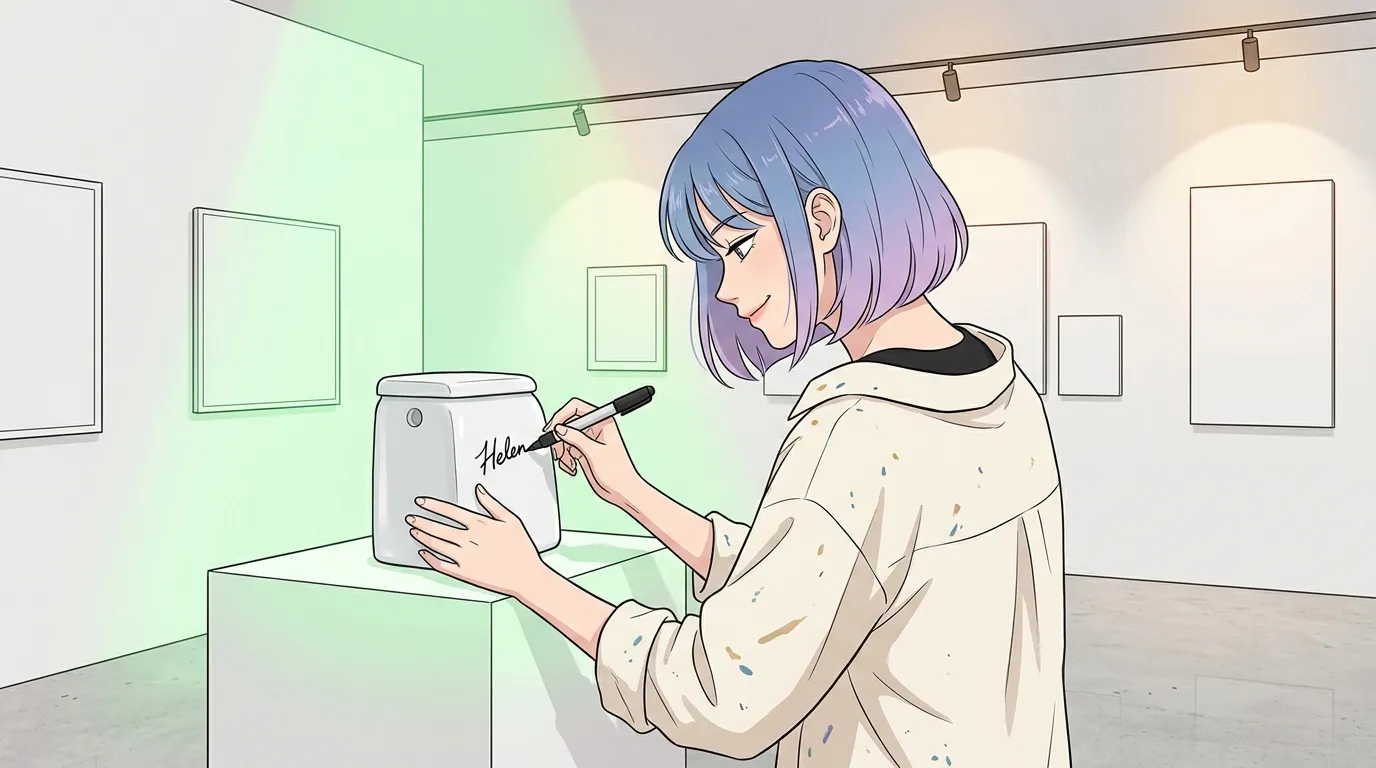
 Helen assinando um readymade tech
But there lies the interesting contradiction in the revolt against whoever uses AI to create and signs the "work". If, on one hand, AI takes away the traditional artist's command over technique and style, on the other, the visceral and aggressive reaction against those who use AI tools exposes a deep pain. It is the frustration in the face of the fact that the world changed radically, and manual skill, while it remains admirable, is no longer the only and most powerful way to produce meaning.
If Duchamp's appropriation shocked the world by redefining what art was, AI does something very similar to the idea of authorship. Signing a work made with AI is not different, conceptually, from Duchamp signing an industrialized urinal (which, it must be said, he did not even know how to design or manufacture). The central question shifts from execution to curation, intention and communication. Who contextualizes, who provokes, who delivers the message?
Today, what is being "sold" is no longer just technique, but the eye, the curation, the synthesis of the "artist" or "creator" or "mere common human", their capacity to generate context, to create resulting meaning.
 Um prompt emoldurado num museu classico
Yet many seem to be fighting a tsunami with an umbrella. These raging attacks are more a symptom of resistance to change than a real defense of "true art" which, let's be honest, was always a flexible, unstable and provocative concept. One of the Pandora's boxes has been opened.
It is not hard to foresee that, a few years from now, works created by AI today will be seen with different eyes, as milestones of this brutal transition (toward something better or worse depending on your bias). But moving in the direction of expanding our understanding of the concept of creativity.
And what do you feel?