I spent a week looking for the wrong door.
The idea was simple: draw the shots on a storyboard sheet, hand it to the generator, get the video back obeying it. I opened Seedance looking for where to upload the sheet. I opened Veo. I opened the others. None of them has a storyboard field. There's "reference image", and that's all there is.
It took me a while to understand that the missing field is not a hole in the product. It's how the thing works.
The sheet goes in through the same slot as any photo. The generator doesn't know that's a script. It sees an image. What promotes the sheet to script is a sentence in the prompt saying what to do with it: these are the shots, in this order, and ignore the pencil strokes.
That changes where the work lives. It's not drawing better. It's declaring better.
 Helen empurrando uma folha de storyboard de nove painéis dentro da fenda iluminada de uma máquina escura, com a mão ainda segurando a borda.
The storyboard matters
What's on the sheet gets into the film.
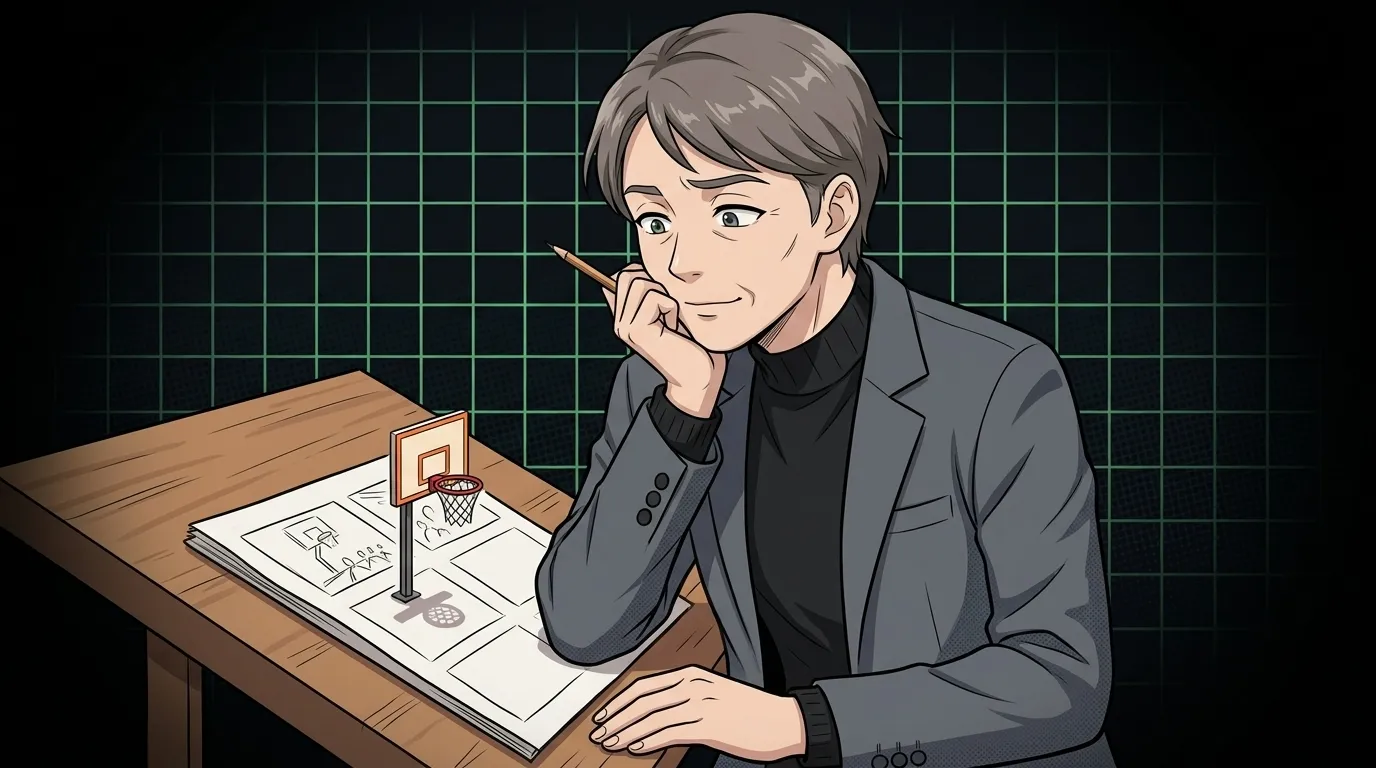
I learned this the expensive way. One of my sheets drew basketball backboards into the background of two panels. I didn't ask for them, hadn't even noticed them before sending. The take came out with basketball backboards.
The engine doesn't distinguish "scenery that showed up in the drawing on its own" from "art direction". To it, everything is reference pixels, and reference is there to be followed.
The rule that remains is short and annoying to obey: what you don't want in the video cannot be on the sheet.
What each panel carries
A panel on the house sheet has five fields, and none is decoration:
- BEAT, the address. It's how the prompt points at the right cell.
- SHOT, scale and angle together (open profile, medium frontal, wide high-angle).
- SOUND, what you hear at that instant.
- CAMERA, and only when it changes. A constant camera lives in the header.
- The action, one line, frozen at that instant.
The criterion is single: a field that doesn't turn into anything in the video leaves the sheet. If you write "melancholic" and can't point at what changes in the image because of it, that's not direction, that's an adjective.
The frame is yours, the panel box is not
This is the part almost everyone gets wrong on their first pretty sheet: the sheet has two layers with opposite rules.
The frame is where the house signs: header, data bar, rules, footer, typography, the brand color. Go ahead and polish it: it exists for humans to read.
The drawing box is where the scene lives, and inside it the rule flips: brand-neutral, no text, no house color. Nothing.
The reason is law number one again. What's inside the box leaks into the take. I put the brand green inside the box once and got back an entire film tinted green. The engine didn't read that as visual identity. It read it as scene lighting.
Which engine can hold a grid
Here the choice of engine matters more than for a standalone image, for one specific reason: the grid. A nine-panel sheet asks for nine separate frames, in order, with the same character, plus small legible text in each. A weak engine shuffles the panels, merges two into one, or delivers melted lettering.
Three can hold it today: gpt-image-2 in high mode, Gemini 3 Pro and Seedream 5.0 Pro, and even they fail sometimes.
This sheet came out of gpt-image-2 high, and the choice wasn't aesthetic: it's the only one on the shelf that delivers small legible lettering, and here every panel carries five written fields.
But choosing the engine is not just choosing quality. Each model arrives with its own assumptions about how the world works, inherited from training, and you don't switch them off. Change the version and the same prompt with the same sheet delivers a different film.
The clause that turns an image into direction
The sheet alone directs nothing. What directs is the video prompt declaring its role. The clause I use, in English because that's the language the engine was trained in:
Use the first reference image (a monochrome 9-panel storyboard contact sheet)
as a STRICT BEAT 01 to BEAT 09 path: each panel's angle, framing, pose and
contact geometry is a required fleeting waypoint, reached once in order,
without skips or merges. Ignore the pencil texture and the sheet furniture.
Three things make that sentence work.
"Waypoint" and not "frame". The panel is a point the scene passes through, not a frame it freezes on. Without that, the engine delivers nine static poses stitched together, which is the AI-video look everyone is already tired of.
"Once in order, without skips or merges". Without that part it reorders, skips and merges panels with pleasure.
"Ignore the pencil texture". Without that, the film comes out in pencil. Law number one doesn't spare even the stroke.
And the rule that governs everything else: affirmation only. A prompt that says "don't make the camera spin" spends the engine's attention budget on the word "spin" and still delivers a spin. A prompt that says "camera locked on the tripod" delivers a locked camera.
The sheet and the film that came out of it
The sheet here is THE ROOFS, a rooftop chase in eight shots. The take that came out of it: fifteen seconds in one breath, no cut.
 Folha de storyboard THE ROOFS: oito painéis a lápis de uma perseguição em telhados, cada um com BEAT, PLANO, SOM, CAMERA e a linha de ação embaixo.
THE ROOFS take, fifteen seconds generated from the eight-panel sheet
What crossed over was the silhouette. The capped guard stays behind and to the left across all eight shots, the coated thief ahead and to the right, and the gap between them opens and closes in the drawn order. Neither has a face on the sheet: what separates one from the other is the silhouette, and silhouette is what a scribble preserves best.
What didn't cross over was the angle. All eight shots came out in profile. I had written only the scale in the SHOT field and left the angle open, and an open angle the engine always resolves toward the cheapest option, which is the side view. The sheet didn't disobey. It obeyed what I didn't say.
That's why the SHOT field carries scale and angle together. The rule wasn't born from theory, it was born from that take.
The sheet is optional
Now let me disarm the impression this text leaves: that the sheet is "THE way to direct". It isn't. It's one instrument among others, and not always the right one.
Around here I use three:
- The sheet answers what. What happens and in what order. On its own, the engine follows your order and fills in the rest.
- The deepshadow answers how. It's the choreography and the camera taken from a clip that already exists, movement without face and without clothes. On its own, the gait is that one and the whole scene comes from your prompt.
- The character answers who. The face and the manner that hold, whatever you make them do.
You take one, two or all three, and any combination produces a take. You can direct an entire scene without drawing a single panel, if what needs locking is the gait and not the order of the shots.
The limit is a field limit, not a method limit: Seedance takes four reference images plus one motion video, Veo takes three.
Choosing which rein to pull is already half the direction. The useful question before drawing anything is not "how do I make the sheet", it's "what in this scene can I not leave for the model to choose".
 Helen sentada na cadeira de diretora segurando três rédeas que saem do quadro em direções diferentes, com uma folha de storyboard enrolada no colo.
Nothing rules alone
The part that took me longest to accept: whatever the combination, no piece of it has the final word.
 The sheet gets things wrong, and often. My bar sheet drew a character who migrates to the other side of the counter between one panel and the next, and left a key stuck to the wood with no clause saying how it gets out of there. None of that was asked for. All of it entered the film.
And that's not a bug. The sheet is imperfect by design. A sparse panel is a deliberate choice, because the more detail you draw, the more chances the engine has to invent a prop, an extra limb, a word on the wall. An over-polished sheet directs worse than a rough sketch.
What exists is a distribution of authority, and it's not fixed. Each reference rules over what it knows how to answer: order and framing on the sheet, gait in the deepshadow, identity in the character.
The take's text rules over what the drawing omitted, and it omits a lot: anatomy, material, finish, everything a scribble doesn't decide. And the model rules over the rest without asking permission, with the physics and the continuity it brought from training.
That's why the basketball backboards showed up. Not because the sheet commanded and the engine obeyed, but because the pieces added up and nobody was looking at that corner of the frame.
A town in Spain with opening hours for the street
I used to treat this instability as the technology's immaturity, something the next version fixes. I was wrong, and the analogy that convinced me comes from a film set.
A big production is not a controlled laboratory either. The actor has opinions about the character and takes the scene somewhere the script didn't foresee. The gaffer points out a better route for the light and the shot changes. The makeup melts because the day got hot. The street is in a Spanish town that only opens at certain hours. There's the original book, which the fans know by heart, and there's the director's eye, which disagrees with the book on three points, and the screenwriter's, which disagrees with the director on two.
The film that comes out of there is not the execution of the storyboard. It's what survived the negotiation between all those pressures. And nobody calls that a failure of direction. That is direction.
Different worlds, obviously. One has real physics, real people, money sitting idle waiting for the sun. The other has a graphics card. But the structure carries across: in neither of them is there a sovereign input.
The difference that matters is another one, and it's worth naming. On set, the other wills are people, and people can be talked to. With the actor you ask, explain, negotiate, redo. A model's assumptions don't negotiate. You only find out they exist after they've shown up in the take, and what's left is learning to manage them.
So directing here is less recipe and more management. You choose which reins to pull, you write down what cannot be left to the house, and you manage what comes back. It will stay unstable, not because the tool is immature, but because direction with many hands is like this everywhere. What grows with practice is not control. It's repertoire: of the tool, of the flow, of the kind of brush.