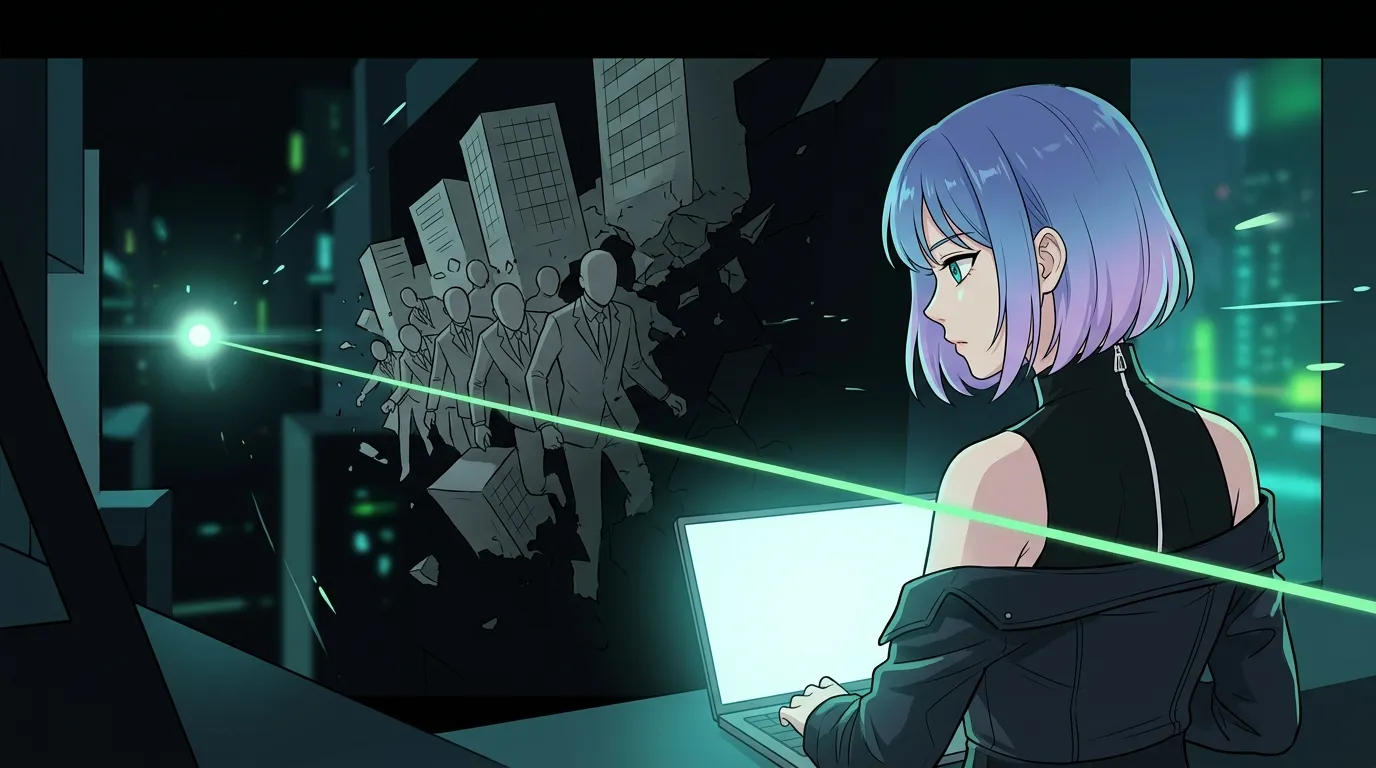
There's a video going around this week of a tiny drone chasing an insect across a white room and shredding it mid-air. The easy reading is "the end of bug spray has arrived". The one that interests me is another: the thing has no camera. It hunts by ear.
Tornyol - Micro-drone that kills mosquitoes
The people behind it are Tornyol, two French engineers, Alex Toussaint and Clovis Piedallu, who went through Y Combinator (the accelerator that put half of Silicon Valley on its feet). The promise is to replace chemical spraying with a swarm of 40-gram drones that patrols your backyard and kills mosquitoes in the air, one by one. Their math: 10 drones per square kilometer, control costs falling 100x, against the 700 thousand people who die every year from mosquito-borne disease.
I'll get to the part that bothers me. But it only makes sense after you understand the engineering, because the problem lives exactly inside what's beautiful here.
Listening
The smartest decision in the project was a subtraction.
Anyone can build this drone with computer vision, and anyone dies in the same two places: 40 grams don't carry a GPU, and mosquitoes attack in the dark. A camera is the obvious answer, and the obvious answer doesn't fit the beast.
So they went looking for what was left lying around cheap in the world. They found two things: phone microphones and car parking sensors. Two parts that exist by the billions because another industry already paid the bill for scaling them. The base station bundles 380 of those microphones into an array, fires an ultrasonic pulse and reads the echo that comes back.
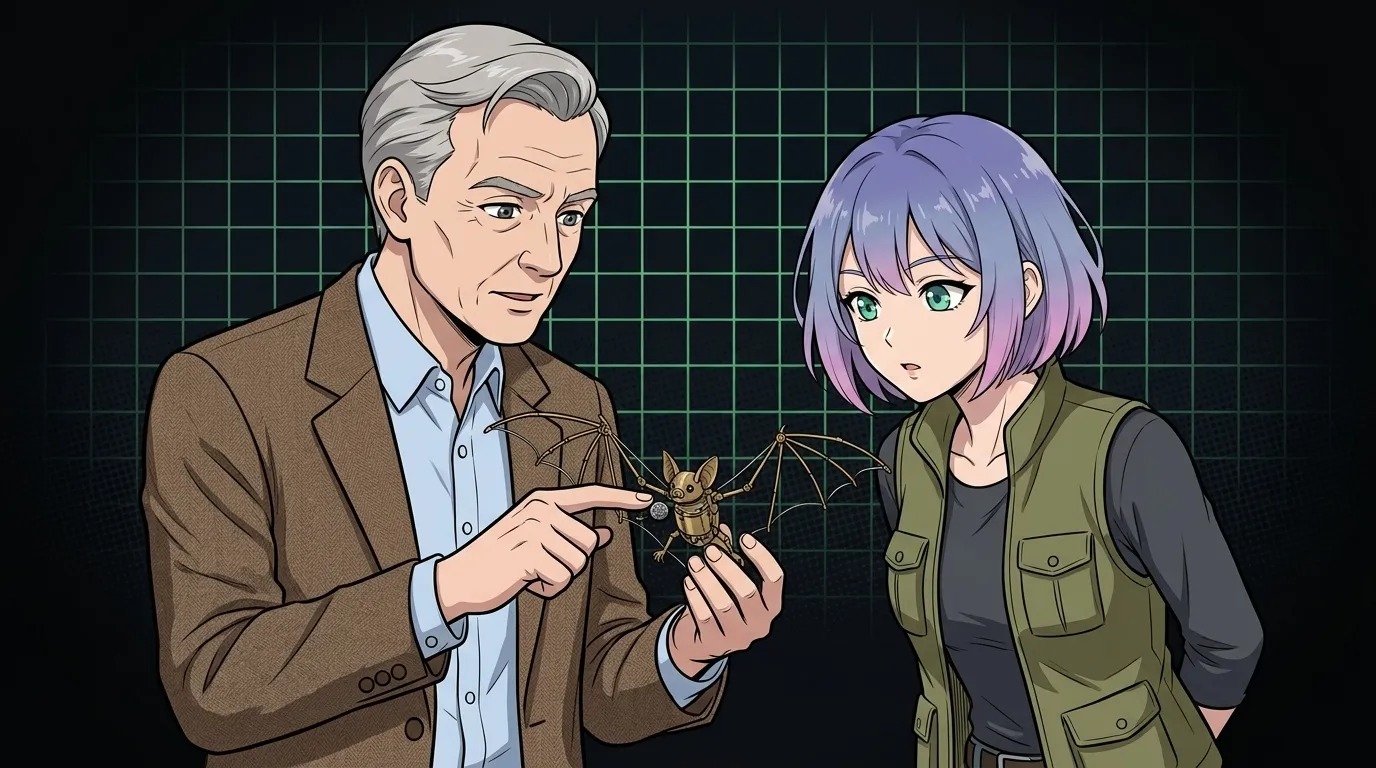
That's echolocation. That's a bat.
It's worth feeling the weight of that for a second. The bat doesn't see the moth in the dark, it shouts and listens to the world come back. The information isn't in the light, it's in the delay and the deformation of the returning sound. Tornyol didn't invent this: they copied a solution that had been running in production for about 50 million years, and implemented it with off-the-shelf parts.
That's the kind of move I think we underestimate. It's not "I used cutting-edge AI". It's "I looked the constraint in the face and it handed me the architecture". The camera didn't fit, and the camera's absence became the advantage: sound works in the dark, spends less energy, and carries information a silhouette doesn't.
 The anatomy of constraint: cheap sensors and sonar
Choosing
Then comes the part that separates this from an electric bug zapper.
An insect's beating wing doesn't just return a "something's there". Each wingbeat prints a frequency-shift pattern into the echo, what the literature calls a micro-Doppler signature. A mosquito beats in one band, a bee in another, and the drawing each one leaves in the sound is different enough to be read in real time. The company claims it can even tell the mosquito's species and sex apart, which makes sense: female and male buzz at distinct frequencies, and it's the female that bites.
Translating: the drone listens, decides whether that's a target, and only then flies in.
Compare with what exists today. Spraying is area bombing. You dump poison over an entire region and kill whatever's in the way, including pollinators, including what eats mosquitoes, and leave residue in your backyard and in your lungs. It's the crudest possible tool for a specific problem.
The drone spares the bee.
That sentence is the entire sales pitch, and it's genuinely good. Replacing an area tool with a target tool is almost always a win: less poison, less collateral damage, fewer things dying for being in the wrong place. As I see it, this is the first case in a long time where "put AI in it" produces an ecologically better result, not just a faster one.
Hold on to that sentence, because it's the one that becomes the problem in the next section.
 The line between protection and targeting
Aiming
The drone spares the bee because someone wrote that the bee is not a target.
There is nothing in the hardware protecting the bee. The microphone hears the bee just the same. The sonar finds the bee just the same. What stops the drone from killing the bee is a decision line in the software, and a decision line is the easiest thing in the world to change. The ability to discriminate is not a safety lock. It's a parameter.
And this is where the résumé weighs in. Before Tornyol, Toussaint worked at MBDA, the European missile manufacturer, on navigation and guidance. He didn't change subjects when he left, he changed scale. The math of detecting a moving target, predicting where it's going and placing yourself at the interception point is the same math, with a smaller target and a worse battery.
I'm not accusing anyone of secretly building weapons. I'm saying something more uncomfortable: this is the architecture of an autonomous interception system, and it now exists in a 40-gram version, built from off-the-shelf parts, for 1,100 dollars. Whoever wants to swap the target list doesn't need new engineering. They need a different file.
The dream of this house has always been exactly this: the barrier to entry falling, the individual coming to do what used to require the structure of a State. I believe in that and it's where I place my bets. But the argument doesn't come with a goodness clause. The same falling barrier that puts a film studio in your laptop puts autonomous interception in a garage, and the difference between one case and the other is not technical, it's intent. Pretending only the good half trickles down is naivety, and the people who build are exactly the ones who can't afford it.
What the video doesn't show
Now the honest part, because there's a wide gap between the demo and the promise.
🔹 The victim was a moth. The first confirmed air-to-air kill, on the 14th, was not a mosquito. It was a moth, much bigger and slower.
🔹 The room was white and empty. Controlled environment, no curtain, no fan, no dog walking through.
🔹 The battery lasts 3 minutes. And recharges in about 30. Do the duty-cycle math: the mosquito has plenty of time to regroup.
🔹 Tracking range is about 8 meters. A small backyard, not a neighborhood.
🔹 The price is first-world. 50 dollars a month. The people who actually live with dengue and malaria are not the customer this price describes, for now.
None of this disqualifies the project. This is exactly what a good prototype looks like at this stage, and anyone who has built anything knows it. What bothers me is not that the drone is raw, it's the feed reading a demo as a product. They are different things, and confusing the two is the most expensive mistake around today for anyone following AI from the outside.
Conclusion
I like this project. I like the subtraction that became architecture, I like swapping area poison for a specific target, and I like people who look at a public health problem that kills 700 thousand people a year and decide to attack it with a car parking sensor.
What I can't separate is this: the thing that makes this drone ethically better than the pesticide is the same thing that makes it dangerous. Precision is not a virtue of the system, it's a capability of it. It spares the bee today because the target list says so today.
A tool that chooses targets moves the question from "what can it do" to "who writes the list". And that second question, engineering doesn't answer.
There's one detail I can't get out of my head. This drone's first prey was a moth. The moth is the animal that spent tens of millions of years in an arms race against bat sonar, and some species evolved ears to hear the bat coming and even clicks that scramble its sonar.
She lost this one. But she's the only one in the room who has played this game before.
And you, are you optimistic or uncomfortable with this?